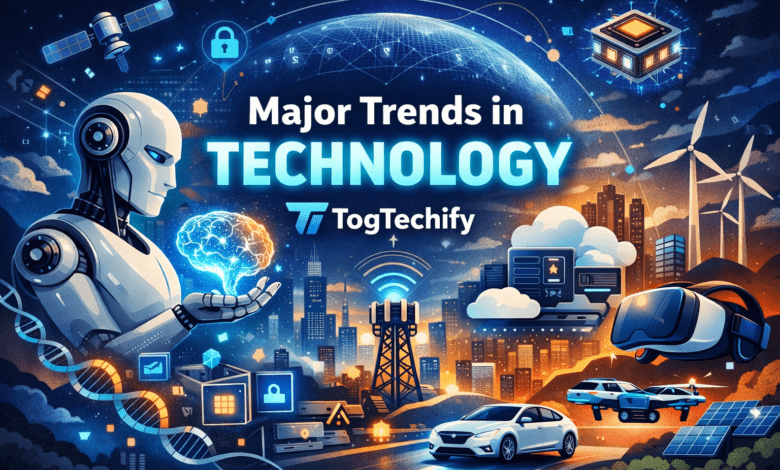
Major Trends in Technology TogTechify In-Depth Guide to the Future of Innovation
Introduction: Technology at the Heart of a Rapidly Changing World
Technology is no longer a separate industry operating on the sidelines of society. It has become the backbone of modern civilization, influencing how we communicate, work, learn, shop, travel, and even think. From artificial intelligence making decisions in real time to smart devices shaping daily routines, technological advancement is accelerating at an unprecedented pace. Understanding major trends in technology is no longer optional—it is essential for businesses, professionals, and everyday users alike.
At TogTechify, we closely track emerging technology trends that are redefining industries and reshaping the global digital landscape. These trends are not isolated innovations; they are interconnected forces driving long-term transformation. Organizations that recognize and adapt to these changes early gain a competitive edge, while individuals who stay informed can better navigate a tech-driven future.
This comprehensive guide explores the major technology trends dominating today’s innovation ecosystem. From AI and blockchain to green technology and quantum computing, this article provides a deep dive into how these trends work, where they are being applied, and what they mean for the future.
Artificial Intelligence (AI) and Machine Learning: The Core of Digital Intelligence
Artificial Intelligence has evolved from a futuristic concept into a practical, everyday technology. Today, AI systems analyze vast amounts of data, identify patterns, and make decisions faster than humans ever could. Machine learning, a subset of AI, enables systems to learn from experience without being explicitly programmed, making applications smarter over time.
Generative AI has become one of the most disruptive forces in recent years. Tools that generate text, images, videos, and even software code are transforming industries such as marketing, education, software development, and entertainment. Businesses now rely on AI-powered chatbots for customer service, predictive analytics for decision-making, and recommendation systems to personalize user experiences.
However, the rise of AI also introduces ethical challenges. Issues such as algorithmic bias, data misuse, job displacement, and lack of transparency are major concerns. Governments and organizations are increasingly focusing on responsible AI development, emphasizing fairness, accountability, and explainability. As AI continues to mature, its integration into everyday life will deepen, making it one of the most influential technology trends of the modern era.
Internet of Things (IoT): A World Connected by Smart Devices
The Internet of Things refers to a network of physical devices embedded with sensors, software, and connectivity, allowing them to collect and exchange data. From smart thermostats and fitness trackers to industrial machines and traffic systems, IoT devices are transforming how environments operate.
In homes, IoT enables automation and convenience. Smart lighting, voice assistants, and connected appliances allow users to control their living spaces with minimal effort. In industries, IoT plays a critical role in predictive maintenance, supply chain optimization, and operational efficiency. Smart factories leverage real-time data to reduce downtime and improve productivity.
Despite its advantages, IoT presents security challenges. With billions of connected devices, vulnerabilities increase significantly. Cybercriminals can exploit weak security protocols, making data protection a top priority. As IoT adoption grows, stronger encryption, better authentication methods, and global standards will be essential to ensure secure and reliable connectivity.
Blockchain and Web3: Redefining Trust and Digital Ownership
Blockchain technology is best known for powering cryptocurrencies, but its potential extends far beyond digital money. At its core, blockchain is a decentralized ledger that records transactions securely and transparently. This eliminates the need for intermediaries, making processes more efficient and trustworthy.
Web3, built on blockchain principles, aims to create a decentralized internet where users have control over their data and digital identities. Decentralized finance (DeFi) platforms allow users to lend, borrow, and trade assets without traditional banks. Non-fungible tokens (NFTs) have introduced new ways to own and monetize digital content, impacting art, gaming, and entertainment.
Enterprises are also adopting blockchain for supply chain transparency, digital identity verification, and secure data sharing. However, scalability, energy consumption, and regulatory uncertainty remain challenges. As technology improves and regulations evolve, blockchain is expected to play a significant role in shaping the future digital economy.
Cybersecurity and Digital Privacy: Protecting the Digital World
As technology becomes more integrated into daily life, cybersecurity has emerged as a critical concern. Cyber threats such as ransomware, phishing attacks, and data breaches are increasing in frequency and sophistication. Organizations across all sectors are investing heavily in advanced security solutions to protect sensitive information.
Modern cybersecurity strategies rely on artificial intelligence and automation to detect threats in real time. Zero Trust architecture, which assumes no user or device is inherently trustworthy, is gaining popularity as a more secure approach. Cloud security, endpoint protection, and identity management are now essential components of digital infrastructure.
Privacy is equally important. With growing awareness about data collection and surveillance, users demand greater transparency and control over their personal information. Regulations such as GDPR and other data protection laws are shaping how organizations handle data. In the future, balancing innovation with privacy protection will be one of the biggest challenges in technology.
Cloud Computing and Edge Computing: Powering the Digital Backbone
Cloud computing has revolutionized how businesses store, process, and manage data. Instead of relying on physical servers, organizations now use cloud platforms to access scalable resources on demand. This shift has reduced costs, improved flexibility, and accelerated innovation.
Hybrid and multi-cloud strategies allow businesses to distribute workloads across different environments, enhancing resilience and performance. Serverless computing further simplifies development by enabling developers to focus on code rather than infrastructure management.
Edge computing complements the cloud by processing data closer to its source. This reduces latency and improves real-time performance, making it ideal for applications like autonomous vehicles, smart cities, and industrial automation. Together, cloud and edge computing form the foundation of modern digital ecosystems.
5G and Next-Generation Connectivity: Accelerating Digital Experiences
5G technology represents a significant leap in wireless connectivity. With faster speeds, lower latency, and greater capacity, 5G enables new applications that were previously impossible. From ultra-high-definition streaming to real-time remote surgery, the possibilities are vast.
Industries such as manufacturing, healthcare, and transportation benefit greatly from 5G’s capabilities. Smart factories rely on instant communication between machines, while autonomous vehicles require real-time data processing to operate safely. Consumers experience improved mobile gaming, augmented reality, and seamless connectivity.
Research into 6G is already underway, promising even faster speeds and more intelligent networks. As connectivity continues to evolve, it will serve as a catalyst for innovation across multiple technology sectors.
Augmented Reality (AR) and Virtual Reality (VR): Immersive Digital Experiences
AR and VR technologies are redefining how users interact with digital content. Virtual reality creates fully immersive environments, while augmented reality overlays digital information onto the real world. These technologies are no longer limited to gaming; they are expanding into education, healthcare, retail, and remote work.
In education, VR enables immersive learning experiences, allowing students to explore historical sites or conduct virtual experiments. In healthcare, AR assists surgeons with real-time visual guidance, improving precision and outcomes. Retailers use AR to let customers visualize products before making a purchase.
The concept of the metaverse, a shared virtual space, has further accelerated interest in immersive technologies. While challenges such as hardware costs and user adoption remain, AR and VR are expected to become mainstream tools in the coming years.
Green Technology and Sustainable Innovation: Technology for a Better Planet
Sustainability has become a central focus of technological innovation. Green technology aims to reduce environmental impact while promoting efficiency and renewable energy. From solar power and electric vehicles to smart grids and energy-efficient buildings, technology is playing a key role in addressing climate change.
AI and data analytics help optimize energy consumption, reduce waste, and monitor environmental conditions. Smart cities use technology to improve traffic flow, reduce emissions, and enhance quality of life. Businesses are increasingly adopting sustainable practices, driven by consumer demand and regulatory requirements.
As environmental challenges intensify, green technology will continue to grow in importance. Innovation in this area not only benefits the planet but also creates new economic opportunities.
Automation, Robotics, and the Future of Work
Automation is transforming the workplace by streamlining processes and increasing productivity. Robotic process automation (RPA) handles repetitive tasks, allowing employees to focus on higher-value work. In manufacturing, robots improve precision, safety, and efficiency.
While automation raises concerns about job displacement, it also creates new roles that require advanced skills. Reskilling and upskilling have become essential as the workforce adapts to technological change. Human-machine collaboration is emerging as a new model, where technology enhances human capabilities rather than replacing them.
The future of work will be shaped by flexibility, remote collaboration, and digital tools. Organizations that invest in technology while supporting workforce development will thrive in this evolving landscape.
Quantum Computing and Advanced Technologies: The Next Frontier
Quantum computing represents a fundamental shift in how computations are performed. Unlike classical computers, quantum systems use quantum bits to process information in parallel, enabling them to solve complex problems at unprecedented speeds.
Although still in its early stages, quantum computing holds promise for fields such as cryptography, drug discovery, financial modeling, and climate simulation. Major technology companies and research institutions are investing heavily in this area, anticipating future breakthroughs.
Challenges such as stability, scalability, and error correction remain, but progress is steady. As quantum technology matures, it has the potential to redefine what is computationally possible.
Consumer Technology and Digital Lifestyle Trends
Consumer technology continues to evolve rapidly, shaping how people interact with the digital world. Wearable devices track health metrics, smart assistants manage daily tasks, and mobile apps provide instant access to services.
Digital payments and fintech solutions are transforming financial transactions, making them faster and more accessible. Streaming platforms, social media, and online gaming redefine entertainment and social interaction.
As personalization becomes more advanced, consumer technology will increasingly adapt to individual preferences. This trend highlights the growing intersection between technology and lifestyle.
Challenges and Risks of Emerging Technologies
Despite their benefits, emerging technologies present challenges that must be addressed. Ethical concerns, cybersecurity threats, regulatory uncertainty, and social impact are critical issues. The digital divide remains a significant problem, limiting access to technology for underserved communities.
Managing rapid technological change requires collaboration between governments, businesses, and society. Responsible innovation ensures that technology serves humanity rather than creating new inequalities.
Future Technology Predictions by TogTechify
Looking ahead, technology will continue to converge, blurring the lines between physical and digital worlds. AI will become more autonomous, connectivity will be faster and smarter, and sustainability will drive innovation.
Industries such as healthcare, education, finance, and transportation will experience significant disruption. Individuals and organizations that embrace continuous learning and adaptability will be best positioned to succeed.
Conclusion: Embracing a Tech-Driven Future
Technology trends are shaping the future at an extraordinary pace. From artificial intelligence and blockchain to green innovation and quantum computing, these advancements redefine what is possible. At TogTechify, we believe that understanding these trends is the first step toward leveraging their potential.
By staying informed, embracing innovation, and prioritizing responsible development, society can harness technology to create a more connected, efficient, and sustainable world. The future of technology is not just about tools—it is about how we choose to use them.